Welcome to hykeychain.com
Customized Acrylic Keychains: 5 Best Styles for Your Brand

In the dynamic global markets of anime merchandising, art licensing, creator economies, corporate gifting, and fan engagement, customized acrylic keychains have cemented their status as a high-frequency, high-ROI product category.
Their exceptional optical clarity, precise color reproduction, unlimited shape versatility, and low barrier to entry make customized acrylic keychains the ideal “gateway product” for testing new IP concepts and the perfect “volume driver” for large-scale promotional campaigns.
For procurement managers and brand developers serving diverse regions—from the anime hubs of Japan and South Korea to the creator economies of North America and the booming gifting markets of Southeast Asia and the MENA region—understanding the nuances of customized acrylic keychains is essential to avoiding costly production errors and misaligned brand messaging.
This comprehensive guide to customized acrylic keychains provides a strategic framework for B2B buyers to navigate the selection process across five key dimensions: structural formats, printing techniques, surface enhancements, hardware specifications, and procurement risk mitigation.
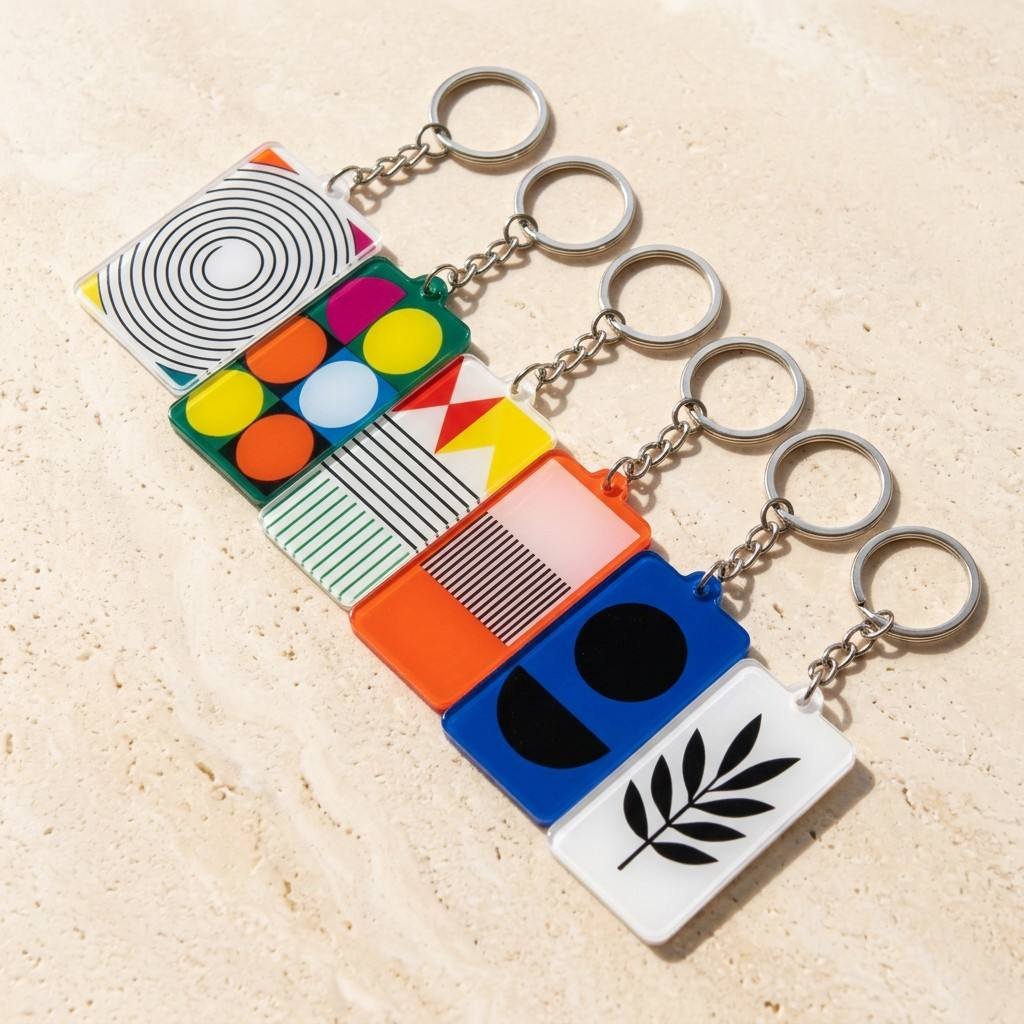
I. Structural Formats: Balancing Durability, Aesthetics, and Cost
The choice of acrylic format dictates the product’s lifespan, visual appeal, and production economics. Four primary structures dominate the global market for customized acrylic keychains:
- Single-Layer Clear Acrylic (The Entry-Level Standard): This is the most ubiquitous and cost-effective format for modern customized acrylic keychains. Manufactured from high-transparency cast acrylic sheets with minimal impurities, the artwork is reverse-printed onto the back surface. When viewed from the front, the image appears suspended within the crystal-clear substrate, creating a “floating” visual effect that is clean and modern. Its primary advantages are rapid production cycles and low unit costs. It is the optimal choice for e-commerce bestsellers, event giveaways, and designs featuring minimalist logos, landscape photography, or anime illustrations where budget efficiency and speed are paramount.
- Double-Layer Sandwich Acrylic (The Durability Upgrade): Designed to address the primary weakness of single-layer keychains—surface abrasion of the printed layer—this format encapsulates the artwork between two sheets of acrylic. This creates a fully sealed, airtight environment that completely isolates the print from external friction, moisture, and dust. Even with constant contact with keys or exposure to occasional washing, the graphic remains pristine. This format is the industry standard for premium retail, high-frequency usage scenarios (such as employee ID badges or daily-use accessories), and long-term inventory programs where product longevity and perceived quality are critical.
- Epoxy Dome / Resin-Coated Acrylic (The Premiumization Driver): Applying a domed layer of optically clear polyurethane resin over the printed surface is a proven method for elevating perceived value in high-end customized acrylic keychains. The convex, lens-like shape of the epoxy adds a tactile 3D dimension, significantly enhancing gloss, color saturation, and visual depth. Beyond aesthetics, the resin layer provides a durable, scratch-resistant, and UV-protective barrier. This process is extensively utilized in the premium segments of pop-culture merchandising, idol fan clubs, and high-end art collectibles, where the added cost is easily justified by higher retail margins.
- Special Effect Acrylic (The Trend-Driven Differentiator): To capture the attention of Gen Z and trend-focused markets in North America, Europe, and Asia, specialty substrates offer unique visual effects. Holographic/Laser-effect acrylic refracts light into a spectrum of rainbow gradients, delivering a futuristic, tech-forward aesthetic highly sought after in anime, K-pop, and streetwear cultures. Glitter/Sparkle acrylic incorporates fine iridescent particles within the sheet itself, creating a dynamic “shimmer” effect that shifts with movement. These formats are essential for “cutecore” aesthetics, magical girl genres, and celebratory event merchandise where visual flair is the primary selling point.
II. Printing Specifications & Hardware: The Details of Professionalism
Printing Logic: Single-Sided vs. Double-Sided
The decision between single and double-sided printing impacts both information hierarchy and cost.
- Single-Sided Printing: Artwork is applied exclusively to the reverse side, preserving maximum transparency on the front. This is the most economical option, ideal for high-volume promotional swag, basic branding identifiers, and designs where the visual message is unidirectional.
- Double-Sided Printing: Graphics can be mirrored on both sides or feature entirely different designs (e.g., a character on one side and their stats or a QR code on the other). This exponentially increases the informational and aesthetic value of the product, making it the default choice for premium retail, fan-centric merchandise, and collector’s items.
Hardware Selection: Functionality Meets Aesthetics
The choice of metal findings (clasps and chains) significantly influences the final look and usability of customized acrylic keychains. While the standard D-ring offers universal compatibility, switching to custom-shaped clasps—such as stars, hearts, cat faces, or branded charms—can dramatically alter the product’s personality at a minimal cost increase. For B2B buyers, aligning the hardware style with the IP’s attributes and the target demographic (e.g., using pastel-colored metal finishes for kawaii brands or matte gunmetal for tactical or streetwear lines) creates a cohesive, high-perceived-value product.
III. Production Logic & Supply Chain Advantages
These high-demand customized acrylic keychains dominate the custom merchandise landscape due to their mature, cost-efficient manufacturing ecosystem:
- Zero Tooling Costs: Unlike injection molding or die-casting, acrylic fabrication relies on UV digital printing and laser cutting. This eliminates the need for expensive molds, reducing the barrier to entry and enabling low Minimum Order Quantities (MOQs). Factories can seamlessly transition from small-batch IP pilot runs (as few as 50 units) to mass-market promotions (10,000+ units).
- High-Fidelity Color Reproduction: Industrial-grade UV flatbed printers accurately render complex gradients, shadows, and industry-standard color matching systems such as Pantone for precise color accuracy, ensuring a near-zero deviation from the approved digital proof.
- Logistics Efficiency: Acrylic is lightweight yet impact-resistant, offering significant advantages over glass or ceramic substrates. This reduces shipping costs and minimizes transit damage, making it an ideal medium for cross-border e-commerce and global distribution networks.
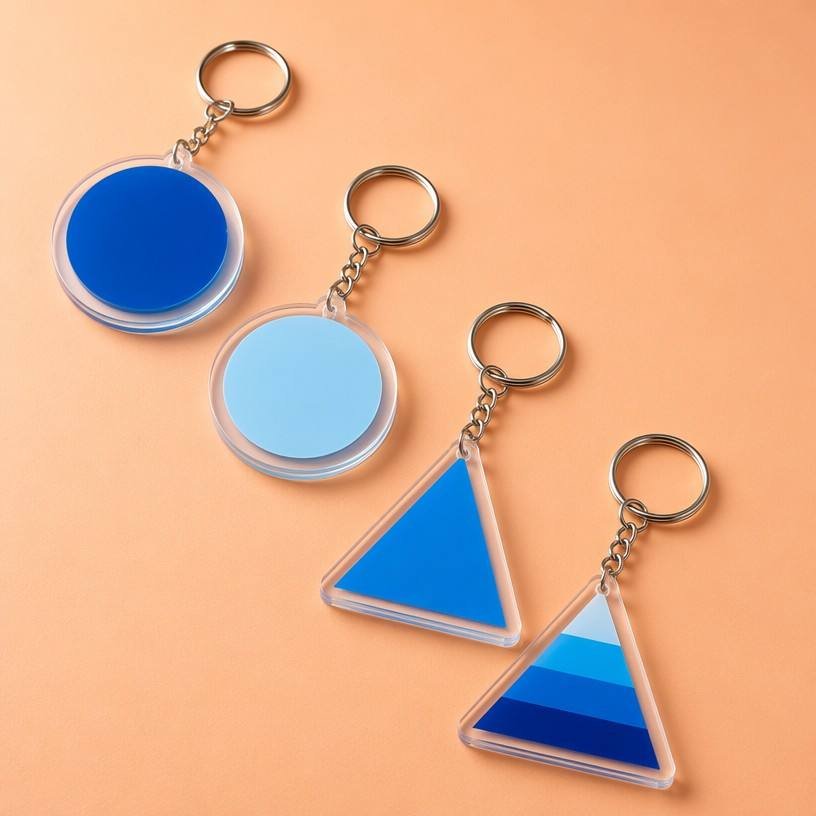
IV. B2B Procurement Risk Mitigation: Avoiding Common Pitfalls
Professional buyers must navigate several technical nuances to ensure a successful production run of customized acrylic keychains:
- The Protective Film Protocol: All acrylic products leave the factory with a peelable protective film on both sides to prevent scratching during transit. It is normal for the product to appear hazy or foggy upon receipt; clarity is restored only after the film is removed. B2B buyers should proactively communicate this to downstream retailers or end-clients to prevent unnecessary customer service inquiries and returns.
- Artwork File Standards: To ensure cutting precision and prevent white edges (“bleeds”), all artwork must be submitted in vector formats (AI, EPS, PDF) or high-resolution PNGs (300 DPI+) with transparent backgrounds. A 1-2mm bleed margin must be incorporated into the design file. Low-resolution JPGs or RGB files with background artifacts will result in production errors and color mismatches.
- Managing Color Expectations: While UV printing excels at full-color reproduction, it cannot replicate fluorescent (neon) inks or true metallic sheens. These specialty effects require silk-screening or specific substrate choices (like metallic acrylic sheets). Always consult with your manufacturer during the pre-press phase to confirm the feasibility of specialty colors.
Conclusion: Maximizing Value in a Competitive Market
The enduring commercial success of customized acrylic keychains lies in their unique ability to deliver “high visual impact, high fidelity, and high flexibility” at a minimal cost. Whether your strategy calls for the budget-efficiency of single-layer clear acrylic, the enhanced durability of double-layer sandwich construction, or the premium positioning of epoxy doming and holographic effects, there is a format tailored to your specific brand objectives and market demands.
For procurement professionals, mastering the sourcing and manufacturing of customized acrylic keychains hinges on understanding these structural differences, enforcing strict artwork standards, and partnering with manufacturers equipped with advanced UV printing and laser cutting capabilities. In today’s saturated merchandise landscape, these customized acrylic keychains are more than just a trinket—they are durable, high-frequency touchpoints that foster emotional connections between a brand and its audience.
- Explore Our Full Custom Acrylic Keychain Collection
- Contact Our Engineering Team for a Free Quote & Digital Proof
Need a recommendation for your custom project?
Send your artwork, quantity, delivery country and target date. Our team will help you compare practical materials, production options and packaging.
Send Your Requirements →Ready to discuss your requirements?
Use our standard inquiry form to request a quote, product catalog or production recommendation.
Get a Quote →Frequently Asked Questions
What should I include when requesting a quote?
Share your artwork or reference image, required quantity, preferred material or finish, packaging needs, delivery country and target date. These details help the production team recommend a practical specification and quote accurately.
Can I confirm a sample before full production?
For custom projects, sample and artwork approval should be agreed before bulk production whenever the design, color matching, construction or packaging requires confirmation. The appropriate sample route depends on the product and order requirements.
How can I check that the finished order matches my requirements?
Keep the approved artwork, material specification, quantity and packaging instructions together in the purchase confirmation. A shipment inspection against those agreed requirements helps identify issues before dispatch.