Welcome to hykeychain.com
Customized PVC Keychains: 2D, 3D, or Printed Options for Your Brand

In the high-stakes world of B2B procurement and custom merchandise, customized PVC keychains remain a cornerstone for promotional campaigns, corporate branding, and retail merchandising. Their mature manufacturing ecosystem, consistent quality control, and exceptional cost-efficiency make customized PVC keychains a reliable choice for businesses across North America, Europe, Southeast Asia, and the MENA region.
However, procurement managers frequently face a critical dilemma when selecting between 2D Soft PVC, 3D Soft PVC, and printed PVC. Choosing the wrong process for your customized PVC keychains doesn’t just waste budget—it can result in a physical product that fundamentally misrepresents your brand’s visual identity. These three methods are not ranked by quality, but by their suitability for different design languages, budgetary frameworks, and commercial objectives. This guide provides a strategic decision-making framework to help you select the optimal process for your specific customized PVC keychains order.
1. Process Principles and Core Characteristics
2D Soft PVC: The Standard for Classic, Layered Designs
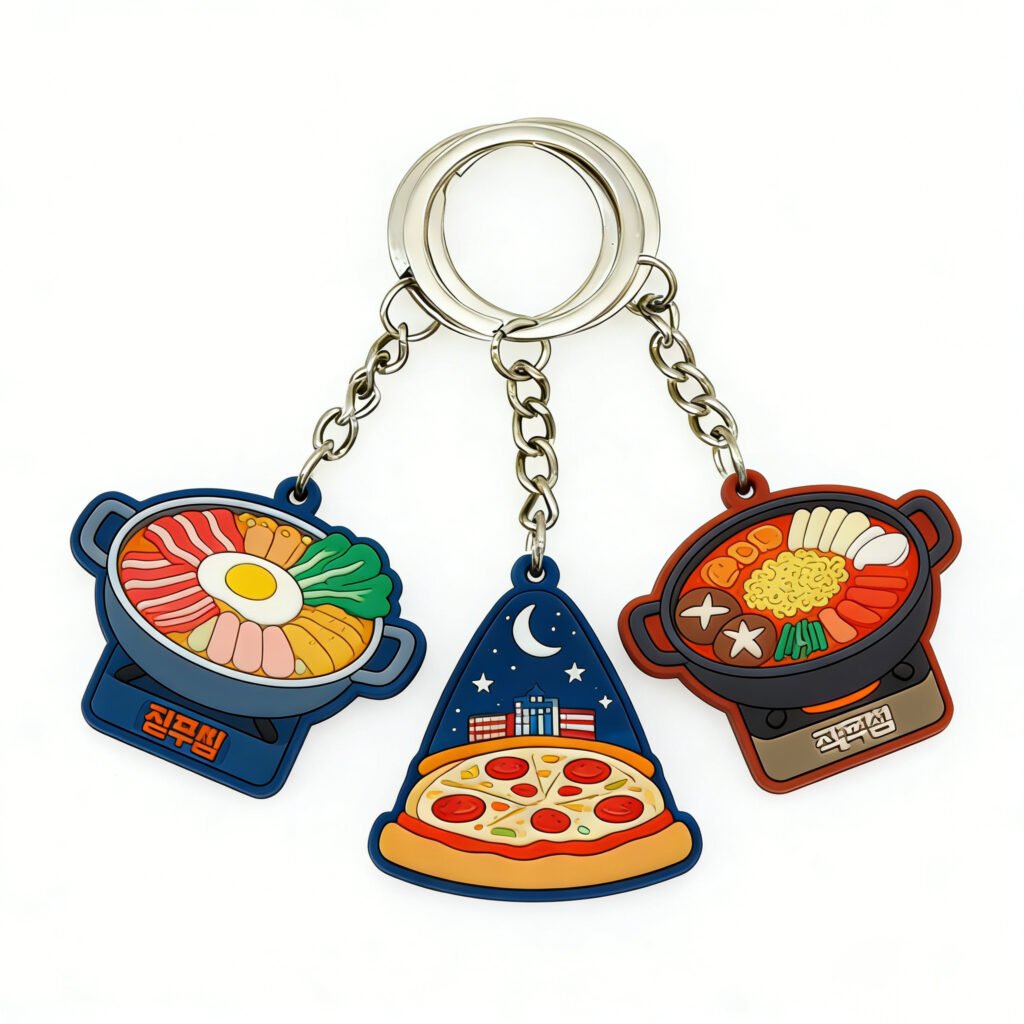
The 2D process is defined by layered construction. Liquid PVC is injected into a mold in successive layers, creating customized PVC keychains with distinct, stepped levels. Visually, this results in sharp, hard-edged color blocks and a clean, planar aesthetic.
- Core Advantage: This is the most established and stable process in the industry. It requires no complex 3D modeling, resulting in the lowest tooling costs and highly competitive unit pricing. It fully retains the inherent benefits of PVC: flexibility, waterproofing, abrasion resistance, and long-term durability.
- Limitation: Due to its physical layering, 2D PVC cannot reproduce gradients, shadows, or complex photographic details. Its visual expression is inherently flat and graphic.
3D Soft PVC: The Premium Choice for Tactile Sculpture
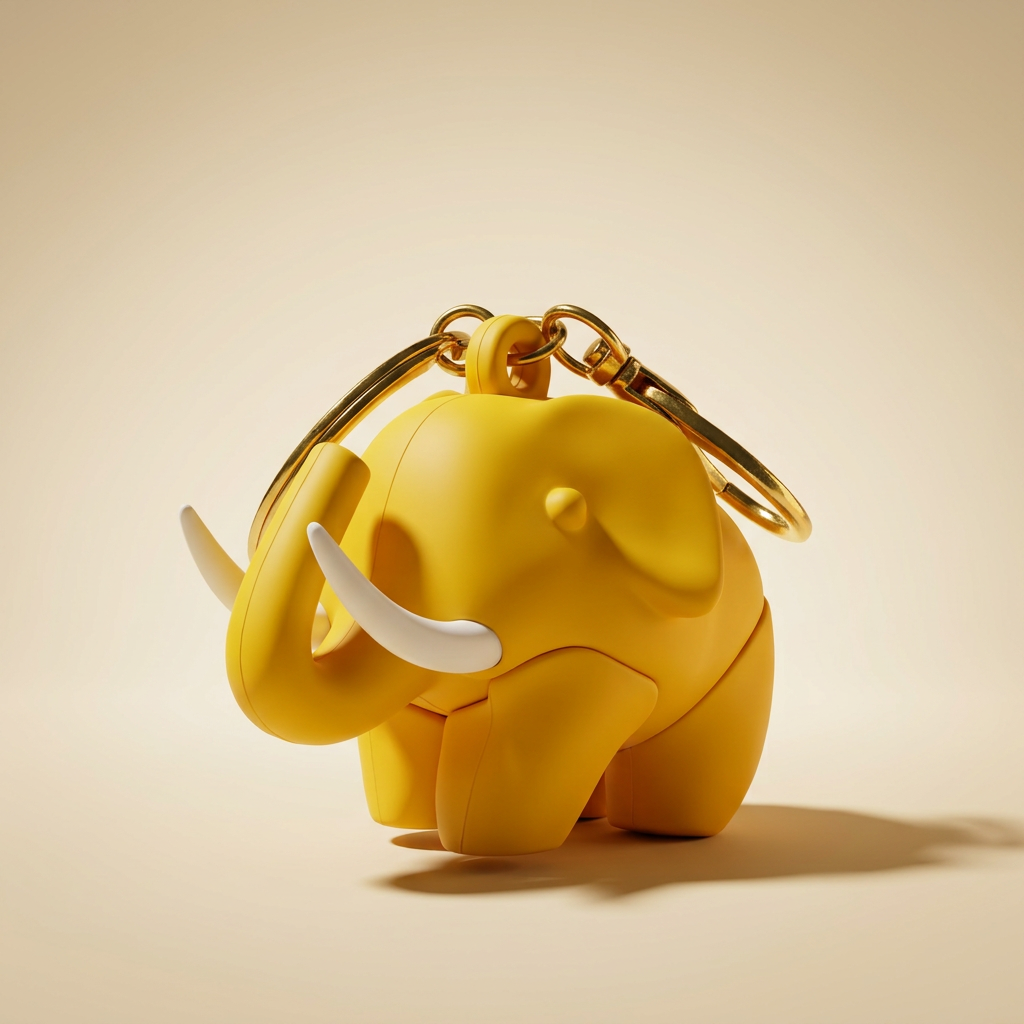
The 3D process is essentially micro-sculpture. It relies on professional 3D modeling and precision steel molds to create customized PVC keychains in a single, unified form via injection molding. The surface features continuous, flowing curves rather than flat steps, allowing for single-sided reliefs or fully dimensional 360-degree designs.
- Core Advantage: 3D keychains offer superior visual impact and tactile quality. The rounded, substantial hand-feel conveys a “collector’s item” perception and high-end brand positioning. Ordering 3D customized PVC keychains commands significantly higher retail margins and effectively elevates brand prestige.
- Limitation: It requires investment in 3D modeling and more complex mold engineering, leading to higher upfront costs and longer lead times. Designs must be conceived with three-dimensional logic, and minimum order quantities (MOQs) are often higher than for 2D options.
PVC Printing: The Solution for High-Definition, Complex Artwork
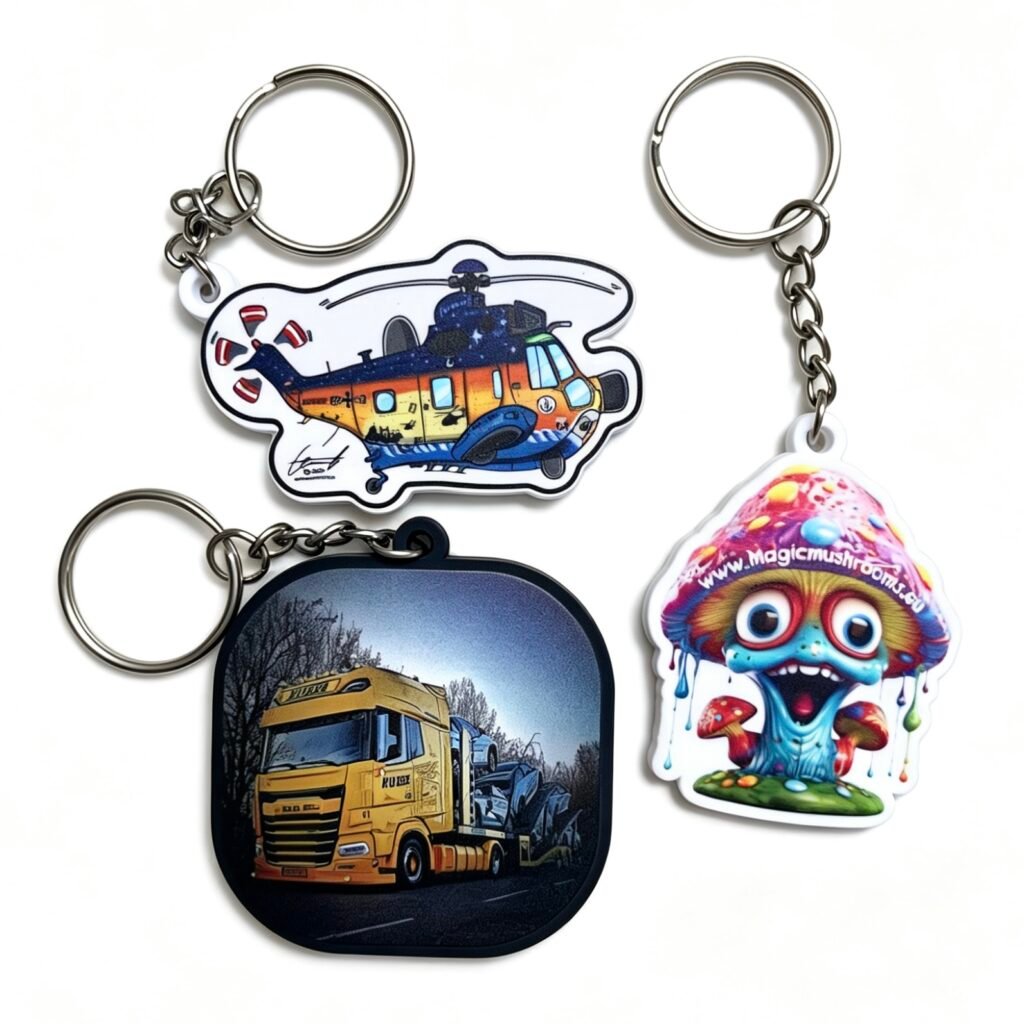
This method utilizes a composite structure: Substrate + Print + Protection. A flat PVC base is first molded, followed by high-definition printing using UV or screen techniques, and finally sealed with a protective epoxy dome to produce customized PVC keychains.
- Core Advantage: This process shatters the “solid color block” limitation of traditional PVC. It is the only PVC-based method capable of reproducing seamless gradients, shadows, photographic portraits, and micro-text with 100% fidelity. It offers unlimited color potential without requiring complex layered molds.
- Limitation: The surface remains flat to the touch, lacking the dimensional relief of 2D or 3D. For simple, solid-color logos in extremely high volumes, unit cost-efficiency may be slightly lower than 2D molding.
2. Multi-Dimensional Comparison & Decision Matrix
To facilitate a rapid decision for sourcing customized PVC keychains, evaluate these processes across critical B2B dimensions:
- Design Adaptability
- 2D Soft PVC: Solid color blocks, clean lines, standard logos, flat icons, and minimalist illustrations.
- 3D Soft PVC: Brand mascots, character figures, product miniatures, sculptural IP, and 3D logos.
- Printed PVC: Gradients, complex illustrations, photographic images, portraits, detailed text, and multi-color designs.
- Visual & Tactile Feel
- 2D Soft PVC: Stepped relief with sharp edges, distinct layers, classic look, and durable feel.
- 3D Soft PVC: Sculpted dimension with rounded curves, substantial weight, and premium collectible feel.
- Printed PVC: Smooth, glass-like epoxy surface with photographic clarity and a high-end glossy finish.
- Cost Structure
- 2D Soft PVC: Lowest tooling and unit cost; the most economical choice for large-volume, budget-conscious campaigns.
- 3D Soft PVC: Higher upfront tooling investment, which is offset by superior perceived value, texture, and brand premium.
- Printed PVC: Mid-range efficiency without complex mold layer fees; highly cost-effective for intricate artwork.
- Optimal Application
- 2D Soft PVC: High-volume promotions, trade show giveaways, corporate gifts, staff IDs, and bulk event merchandise.
- 3D Soft PVC: Retail merchandise, museum shops, limited editions, anniversaries, VIP gifts, and premium retail sales.
- Printed PVC: Detailed merchandise, art collectibles, music festival merch, anime/gaming IP, and photo-based souvenirs.
3. Strategic B2B Selection Framework
Based on the above analysis, procurement professionals should align their choice of customized PVC keychains with specific business objectives:
Choose 2D Soft PVC When:
Your artwork consists of solid color blocks, simple lines, and standard logos. Your primary goal is maximum distribution at the lowest possible cost. This is the default choice for companies needing thousands of customized PVC keychains for trade shows, conference swag, or mass-market brand awareness campaigns where budget efficiency is the absolute priority.
Choose 3D Soft PVC When:
You possess a proprietary brand mascot, a character IP, or need to create a miniature replica of a physical product. The product is positioned for retail sale, limited-edition collectibility, or high-end corporate gifting. The 3D process transforms customized PVC keychains into tangible, tactile assets that justify a higher price point and foster deeper customer loyalty.
Choose PVC Printing When:
Your design features gradients, shadows, photographic elements, or small typography that cannot be achieved through traditional PVC molding. This is the only process that guarantees a 1:1 translation of complex digital artwork into physical customized PVC keychains. It is the definitive solution for brands in the art, gaming, photography, and fashion sectors.
4. Procurement Execution: Best Practices & Risk Mitigation
Once the process is selected, adhere to these operational guidelines to ensure project success:
Artwork File Standards
- 2D & 3D Molding: Always submit vector files (AI, EPS, PDF). For 3D, ensure your design avoids extremely thin, fragile sections that may break during demolding or daily use.
- High-Definition Printing: Provide vector files or high-resolution raster images (300 DPI minimum) with transparent backgrounds. For critical brand colors, supply Pantone (PMS) codes for accurate color matching.
The Critical Importance of Prototyping
- 3D & Printing: Physical pre-production samples of customized PVC keychains are strongly recommended. A 3D sample validates tactile feel, proportions, and structural integrity. A printing sample confirms color accuracy, gradient transitions, and text clarity. Never approve bulk production based solely on a digital mockup.
- 2D Molding: While often skippable for simple re-orders, a physical sample is still advised for first-time designs to verify precise PVC color matching.
Avoiding Cost Pitfalls
- Scrutinize Low Quotes: Ensure supplier quotes specify mold ownership, especially for 3D projects. Clarify whether the mold fee is a one-time payment or amortized across orders.
- Verify Protective Coatings: For printed customized PVC keychains, confirm that the price includes a high-grade epoxy dome coating. Uncoated printed PVC is highly susceptible to surface abrasion, UV fading, and scratching, leading to high customer dissatisfaction and returns.
Compliance and Safety Certification
Ensure your direct factory supplier uses eco-friendly, non-toxic PVC materials and lead-free color pigments. For international distribution, compliance with global safety frameworks is essential:
- European Union: Verify compliance with EU REACH Regulations and EN71-3 safety standards.
- United States: Ensure adherence to US CPSC Safety Rules and California Proposition 65 guidelines.
Partner with a Certified Custom PVC Merchandise Factory
Looking for direct factory sourcing with zero tooling friction, strict international safety compliance, and fast global freight delivery for your customized PVC keychains? We specialize in manufacturing high-impact promotional products tailored for global corporate campaigns and retail brands.
- Explore Our Full Custom Keychain Collection
- Request a Free Quote & Digital Mockup from Our Sales Team
Need a recommendation for your custom project?
Send your artwork, quantity, delivery country and target date. Our team will help you compare practical materials, production options and packaging.
Send Your Requirements →Ready to discuss your requirements?
Use our standard inquiry form to request a quote, product catalog or production recommendation.
Get a Quote →Frequently Asked Questions
What should I include when requesting a quote?
Share your artwork or reference image, required quantity, preferred material or finish, packaging needs, delivery country and target date. These details help the production team recommend a practical specification and quote accurately.
Can I confirm a sample before full production?
For custom projects, sample and artwork approval should be agreed before bulk production whenever the design, color matching, construction or packaging requires confirmation. The appropriate sample route depends on the product and order requirements.
How can I check that the finished order matches my requirements?
Keep the approved artwork, material specification, quantity and packaging instructions together in the purchase confirmation. A shipment inspection against those agreed requirements helps identify issues before dispatch.