Welcome to hykeychain.com
The B2B Sourcing Guide to Custom Webbing Keychains: High-Visibility, Zero-Burden Brand Promotion

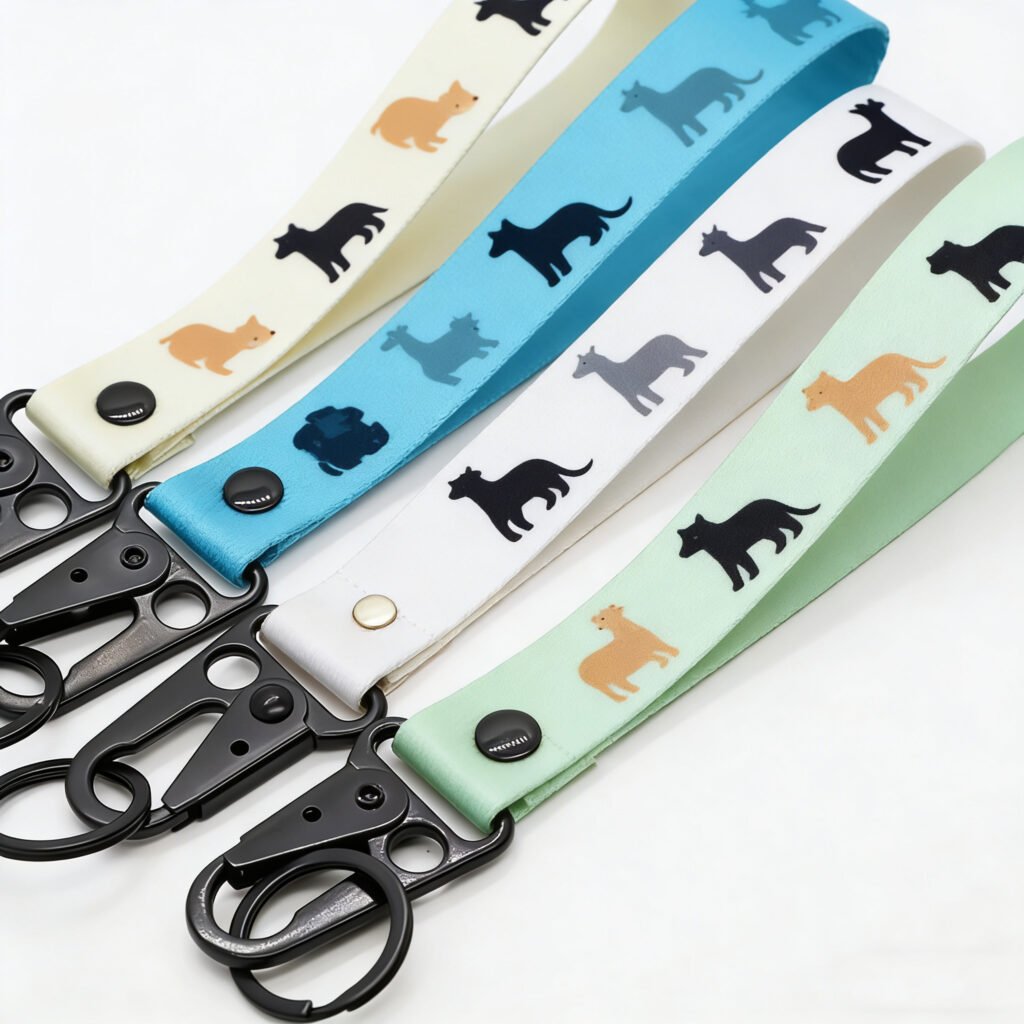
In the high-stakes arena of corporate event marketing, trade show promotions, and offline brand activations, the selection of promotional giveaways directly determines campaign conversion rates and the depth of brand message retention. After extensive market validation across North America, Europe, Southeast Asia, Japan, South Korea, and the MENA region, the custom webbing keychain (also known as a polyester lanyard tag or woven ribbon key tag) has emerged as one of the most frequently reordered promotional products in B2B bulk procurement. It successfully eliminates the physical risks associated with rigid materials while providing an expansive, uninterrupted canvas for brand messaging. For procurement managers and brand strategists, this guide delivers a professional decision-making framework across five critical dimensions: core value proposition, process selection, hardware configuration, scenario adaptation, and procurement risk management.
I. Core Value Proposition: Why Webbing Keychains Excel as Brand Ambassadors
1. Safety, Lightweight, and Universal Applicability
Manufactured from high-density polyester or nylon webbing, these keychains are exceptionally thin, flexible, and resistant to tearing. Unlike metal keychains, they will never scratch automotive paint, smartphone screens, or backpack linings. Unlike acrylic alternatives, they carry zero risk of shattering, making them extremely safe for transport and daily carry. Whether attached to car keys, worn as a wrist accessory, or clipped to a daily bag, they offer a “zero-burden” user experience. This makes them especially suitable for automotive clubs, outdoor adventure groups, and high-frequency commuting scenarios where safety and convenience are paramount. For markets like Southeast Asia and the MENA region, where extreme heat and humidity can degrade lesser materials, polyester webbing’s moisture resistance ensures year-round durability.
2. Maximum Print Area: The Walking Billboard
The elongated, flat shape of a webbing keychain provides a generous, uninterrupted surface for branding. This allows for the clear, complete display of corporate logos, taglines, website URLs, and even QR codes. As users carry these keychains through business districts, airports, and social venues, they effectively function as a “mobile billboard,” generating sustained, high-frequency organic impressions. This dramatically extends the reach of your marketing message far beyond the confines of a single event or trade show floor. For brands targeting the European and North American markets—where trade show attendance often exceeds 50,000 visitors—this ambient exposure translates into thousands of passive daily impressions at a fraction of traditional advertising costs.
3. Long-Term Durability for Extended Campaign Life
Premium webbing keychains undergo tight-knit weaving and high-temperature edge sealing, resulting in excellent abrasion resistance, tensile strength, and water repellency. They resist fading, fraying, and pilling even after years of use. A well-manufactured webbing keychain can remain in service for several years, meaning your brand’s marketing cycle is not limited to a single day of distribution but continues throughout the user’s daily life—building long-term brand equity. This longevity is particularly valued in the Japanese and South Korean markets, where consumers prioritize products that offer lasting utility and minimal waste.
4. Extreme Cost-Efficiency: No Tooling Fees
The production process for webbing keychains is mature and highly standardized. Unlike metal or 3D PVC products that require expensive custom molds, webbing keychains involve zero tooling costs and extremely low minimum order quantities (MOQs). Within the same budget envelope, procurement teams can order significantly higher quantities of webbing keychains compared to hard-good alternatives. Whether distributing thousands of units at a major trade show or testing a small batch for a local store opening, this product delivers maximum reach at minimal cost—making it the ultimate choice for budget-conscious brand awareness campaigns across all global markets.
II. Mainstream Customization Processes
1. Heat Transfer Printing (Full-Color Precision)
Heat transfer technology utilizes heat and pressure to sublimate or transfer ink directly into the polyester fibers, allowing for the complete reproduction of complex graphics, gradients, fine text, and high-resolution photographic images onto the webbing surface. The resulting print is smooth, flexible, and virtually indistinguishable from the base fabric, with exceptional color fidelity. This process is ideal for brands with strict Visual Identity (VI) guidelines, designs featuring intricate artwork, or full-color illustrations that demand photographic realism. It is the preferred choice for fashion labels in Europe and anime merchandise in Japan and South Korea, where visual complexity and color accuracy are non-negotiable.
2. Screen Printing (Bulk Economy Standard)
Screen printing applies opaque ink directly onto the webbing through a precision mesh stencil. It delivers unmatched solid-color coverage, crisp typography, and superior rub-fastness. While it does not support gradients or photorealistic effects, its per-unit cost is significantly lower, and color saturation is exceptionally high. It remains the preferred choice for minimalist logos, corporate slogans, and large-volume standardized production runs. For procurement managers in cost-sensitive Southeast Asian and emerging MENA markets, screen printing offers the optimal balance between professional appearance and budget efficiency.
3. Webbing Substrate & Edge Finishing (The Quality Foundation)
The base material determines product longevity. Procurement professionals should specify thickened, high-thread-count nylon or polyester webbing (typically 1″ or ¾” width) to ensure a substantial hand-feel and prevent premature stretching. Equally critical is the edge-finishing technique: edges must undergo laser heat sealing or ultrasonic welding to create a permanent, fused barrier that prevents fraying, unraveling, or delamination. This edge-sealing step is the primary differentiator between professional-grade manufacturers and low-cost workshops. A properly sealed edge will withstand years of key-ring friction without showing signs of wear.
III. Hardware Selection & Structural Reinforcement
While small in size, hardware components directly impact user experience and product lifespan.
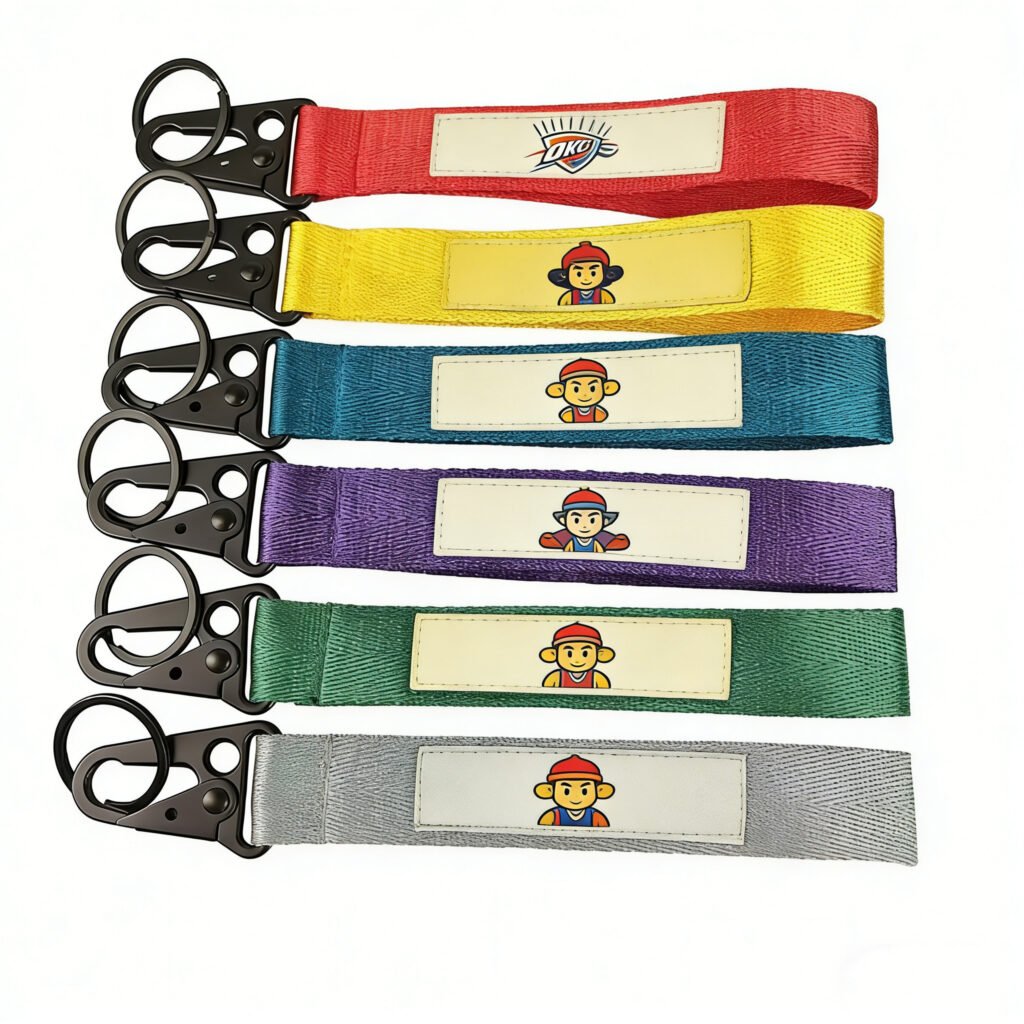
• Clasp Selection: Match the hardware to your brand positioning. Standard metal split rings offer proven durability and universal compatibility. D-rings and lobster clasps provide quick-attach convenience and enhanced security, making them popular for automotive and outdoor applications. Spring-loaded carabiners are ideal for active-lifestyle brands targeting the North American and European outdoor recreation markets.
• Reinforcement Details: The junction where the webbing meets the metal clasp must be reinforced with metal grommets (eyelets) and multiple rows of lock-stitching. This distributes tensile stress evenly, prevents the metal edge from cutting into the fabric, and significantly extends the product’s service life. For B2B buyers, specifying “double-stitched with grommet reinforcement” in your purchase order eliminates the most common failure point in webbing keychains and ensures a professional, long-lasting product.
IV. Scenario-Based Sourcing: Matching Product to Purpose
• Trade Shows, Conferences & Corporate Events: As entry credentials or attendee gifts, these lightweight keychains are easy to distribute en masse. The large-format logo display builds instant brand recognition among target audiences. In the European and North American tradeshow circuits, where attendees collect dozens of items, the practical utility of a keychain ensures it remains in use long after promotional brochures are discarded.
• Automotive Clubs & Outdoor Sports: The soft fabric will not damage vehicle paint—a critical selling point for luxury car brands and automotive enthusiast groups. Its water-resistant and sweatproof properties make it the ideal identifier for caravans, motorcycle clubs, hiking groups, and outdoor adventure teams across diverse climates from the deserts of the MENA region to the rainforests of Southeast Asia.
• Streetwear & Cultural Merchandise: The elongated webbing format is perfect for printing bold slogans, artistic illustrations, or brand manifestos. Used as apparel hangtags or bag charms, they reinforce brand identity and add a tactile touchpoint to the customer experience. This application is particularly strong in the Japanese streetwear market and the South Korean K-pop merchandise ecosystem.
• Campus & Non-Profit Campaigns: Safe, non-toxic, vibrant, and inexpensive, webbing keychains are the perfect choice for university orientations, club activities, charity runs, and community outreach programs. Their low cost per unit allows organizations to distribute them widely without straining limited budgets.
V. B2B Procurement Risk Management & Execution
1. Key Procurement Metrics
• MOQ & Cost Structure: Confirm whether the supplier supports a flexible model combining “low-MOQ test runs + tiered volume pricing” to minimize financial risk. This is especially valuable for startups and small businesses testing new markets in Southeast Asia or the Middle East.
• Compliance & Safety: Insist on documentation proving that both the webbing and inks comply with RoHS and REACH regulations for the European market, and CPSC standards for the United States. This ensures no harmful substances (such as heavy metals, phthalates, or AZO dyes) are present, meeting the stringent requirements for cross-border exports and products intended for children.
• Lead Time Management: A standard production cycle includes: digital proof within 24 hours → physical sample in 3–5 days → bulk production (typically 7–15 days depending on order volume). Always plan backward from your event date, factoring in international shipping and customs clearance, which can add 5–10 days for sea freight or 2–3 days for air express.
2. Standardized Procurement Workflow
1. Specification Submission: Provide vector artwork (AI, PDF, EPS) or high-resolution images (300 DPI minimum), specifying dimensions, process, Pantone colors, and quantity.
2. Digital Proofing: The factory provides a free high-resolution mockup for verifying layout, color placement, and typography before production begins.
3. Physical Sampling (Strongly Recommended): For bulk orders exceeding 1,000 units, always request a pre-production sample to inspect webbing density, print adhesion, edge sealing quality, and stitching consistency.
4. Mass Production & QC: Upon sample approval, production commences with continuous monitoring of edge sealing integrity, print alignment, and hardware attachment strength.
5. Final Inspection & Shipping: A 100% visual inspection removes defective units. Products are individually poly-bagged and packed in export-grade cartons to ensure pristine delivery to your warehouse or fulfillment center.
Conclusion: Engineering a Zero-Burden Brand Asset
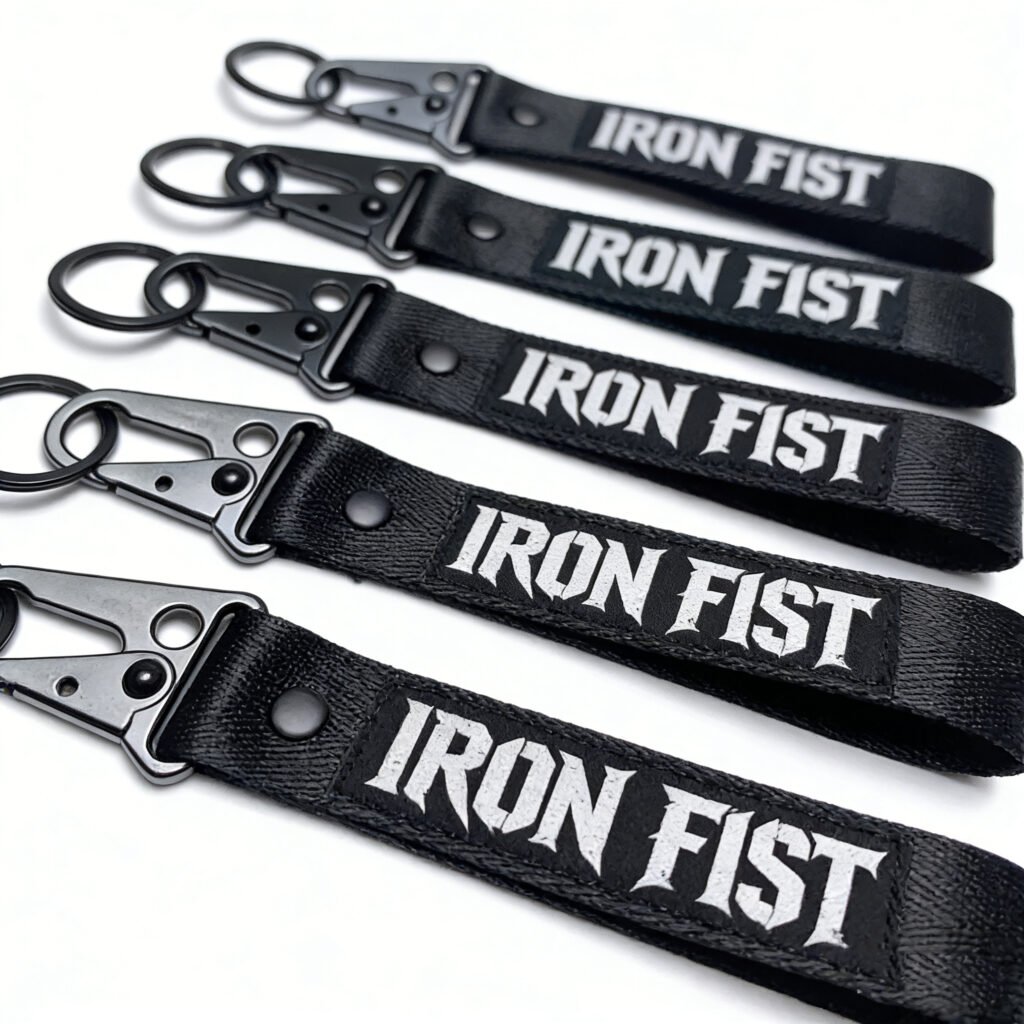
The strategic value of the custom webbing keychain lies in its unique ability to resolve the tension between “long-term brand exposure” and “budget constraints.” It achieves this through exceptionally low cost, superior safety, and an expansive branding canvas. For the B2B procurement professional, success depends on understanding the distinct applications of heat transfer versus screen printing, enforcing strict standards for edge finishing and stitch reinforcement, and partnering with certified manufacturers who prioritize compliance with international safety standards.
In today’s competitive promotional landscape—where consumers from London to Jakarta, Tokyo to Dubai are increasingly selective about the branded items they choose to keep—the webbing keychain offers a rare combination of practicality, affordability, and sustained visibility. Let your brand message travel as far as your audience does, securely and with zero burden. The webbing keychain is more than a giveaway; it is a durable, high-frequency touchpoint that turns every customer interaction into a lasting brand impression.
Ready to customize your branded fabric keychains? Contact our expert team today for a free design proof and a quick quote!